CGT Calculator Momentum, Media Coverage, and the Latest Policy Signals
A practical weekly round-up for advisors and business leaders in Northern Ireland. Clear next steps. Useful links. No fluff.

Hello everyone
Catherine here from Employee Ownership Ireland. This week has been a good reminder that people want clarity and practical tools. They also want balanced coverage that doesn’t reduce employee ownership to one tax headline.
Since the recent CGT changes, a lot of conversations have shifted quickly from “is employee ownership still worth exploring” to “how do we sense-check the numbers and move forward with confidence”. That is exactly where good information, good modelling, and good advice matter.
Below, I’ve shared what we’re seeing on the ground in Northern Ireland, what’s worth reading, and what you can do next if you’re supporting a client, planning succession inside your own business, or simply trying to stay close to how the policy landscape is evolving.
Strong response to the CGT comparison calculator
We’ve had a really positive response to the EOI CGT Comparison Calculator. People tell us it helps them move from general discussion to a structured conversation. It gives a clearer starting point for owners and advisors who want to sense-check options.
The reason it’s landing well is simple. It helps you take a headline change and turn it into a practical conversation. Owners want to know what the change means in pounds and pence. Advisors want a quick way to frame an early conversation without over-complicating it.
If you have not used it yet, try it with one real scenario you are currently discussing. It can help highlight which questions matter most at the outset. In many cases, that is not the relief percentage itself, but issues such as funding approach, repayment profile, governance comfort, or the long-term intention for the business.
Here is what I’d encourage you to do. Use the calculator as a first pass, then bring it into a wider “succession readiness” discussion. Ask what the owner cares about most. Ask what the business needs to stay stable. Ask what employees will need from communication and leadership if a transition happens.
A question for you. When you talk to clients about succession, do they ask about tax first, or continuity first? The answer often changes how you frame the whole EOT conversation. If you start with continuity, you can then move to tax, funding, and governance in a more grounded way.
Feasibility studies
If a business wants to explore employee ownership properly, a feasibility study remains one of the best first steps. It supports structured decision-making. It also helps owners avoid rushing into a model without stress-testing the detail.
I often describe feasibility as the “calm middle step” between early curiosity and a live transaction. It is where you check whether the business can afford the transition. It is where you start to identify what good governance will look like in practice. It is also where a leadership team can surface risks early rather than trying to solve them under deal pressure later.
A feasibility study also helps businesses avoid false comparisons. An EOT is not the same as a trade sale. It is not the same as management buyout. It is not the same as simply issuing shares to staff. Each option has its own trade-offs, and feasibility helps owners choose a route that matches their goals and their reality.
- Clarifies likely structure and funding route.
- Tests affordability and cashflow logic early.
- Surfaces governance requirements before the deal timetable tightens.
If you’re an advisor, one practical approach is to identify a small list of clients who fit the profile for succession planning in the next one to five years. Then ask a simple question. Do they want the business to continue as it is, with the same people and values, after they step back? If the answer is yes, employee ownership usually deserves a serious look.
Coverage worth your time
We’ve seen strong coverage this week that keeps the focus on long-term value rather than short-term reactions. That matters because many business owners take their cues from what they read in mainstream and sector media. If they only see “tax relief reduced”, they may assume employee ownership is no longer viable. If they also see stories about culture, resilience, and continuity, they are more likely to engage with the full picture.
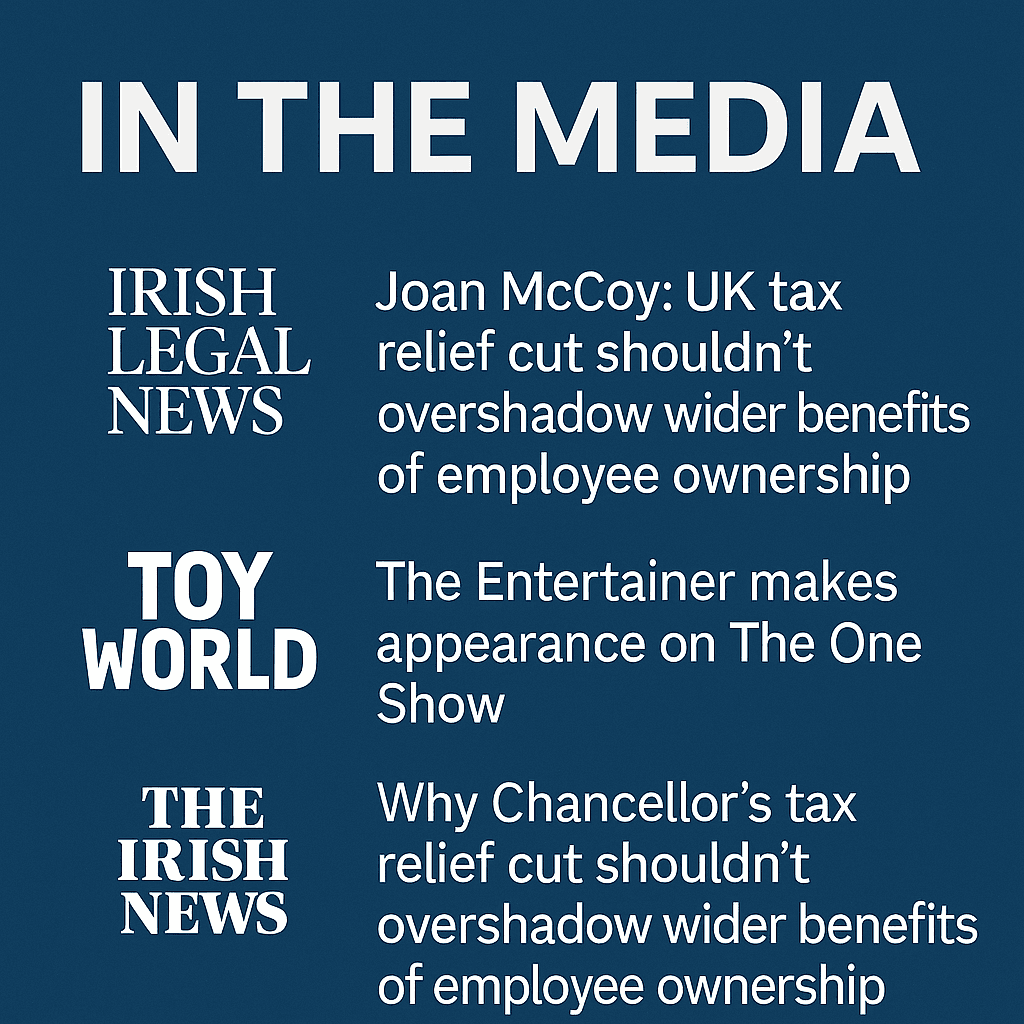
Three recent pieces stood out because they keep the focus on the wider benefits of employee ownership. If you want shareable links for clients or colleagues, start here.
- Irish Legal: Tax relief cut shouldn’t overshadow wider benefits of employee ownership
- Toy World: The Entertainer on The One Show
- The Irish News: Why the tax relief cut shouldn’t overshadow wider benefits
If you are advising a business owner who is anxious about the change, these articles help you re-centre the discussion. The strongest EOT conversations are not built on tax alone. They are built on a clear intention for succession, a realistic funding plan, and a leadership team that wants the business to thrive beyond the founder.
Policy and regulation
HMRC has responded to questions raised by the Employee Ownership Association following the CGT changes. This matters because it shows continued engagement with the sector and helps clarify interpretation issues as they arise.
In practical terms, this is what businesses and advisors want right now. They want clarity on how the rules will be applied. They want confidence that legitimate EOT transactions will continue to operate as intended. They also want to understand what additional documentation, governance detail, or compliance steps might become more important under the new environment.
EOA summary link
The EOA shared a concise update on LinkedIn. If you want to keep close to how this is evolving, read it directly:
If you support clients with succession planning, this is a good time to build a simple habit. Track key updates, keep a record of assumptions used in modelling, and encourage owners to avoid rushed decisions based on one headline. The EOT model remains recognised. The rules have changed. Good planning still wins.
Training and events to keep an eye on
If you want to build confidence around trustee roles, governance, culture, or implementation, there are strong options that NI participants can access. These links stay current as dates change.
In Northern Ireland, we are seeing increasing interest in trustee development and advisor capability-building. That is a healthy sign. The best transitions happen when boards, owners, and employees understand what “good stewardship” looks like after the deal completes. Training is often the difference between a trust that simply exists and a trust that actively strengthens long-term performance.
- EOA training and events: employeeownership.co.uk events
- CDS / Scottish Enterprise resources: Scottish Enterprise employee ownership

One practical suggestion. If you are attending training as a firm, pick one person to focus on governance and trusteeship, and one person to focus on funding and structuring. Then compare notes internally. This usually builds stronger capability than sending one person to cover everything.