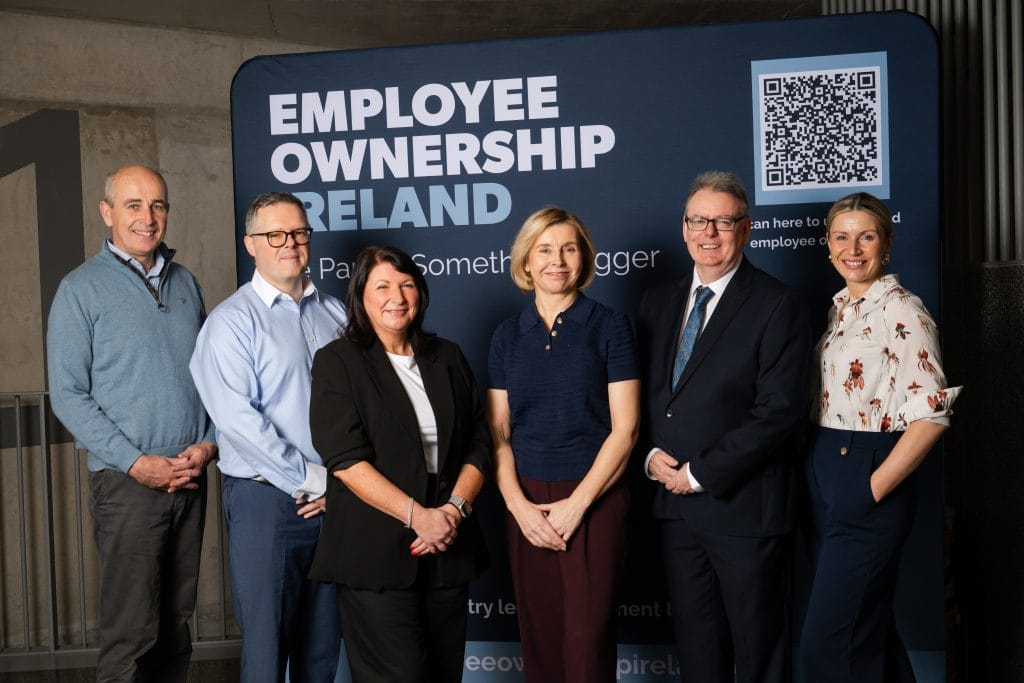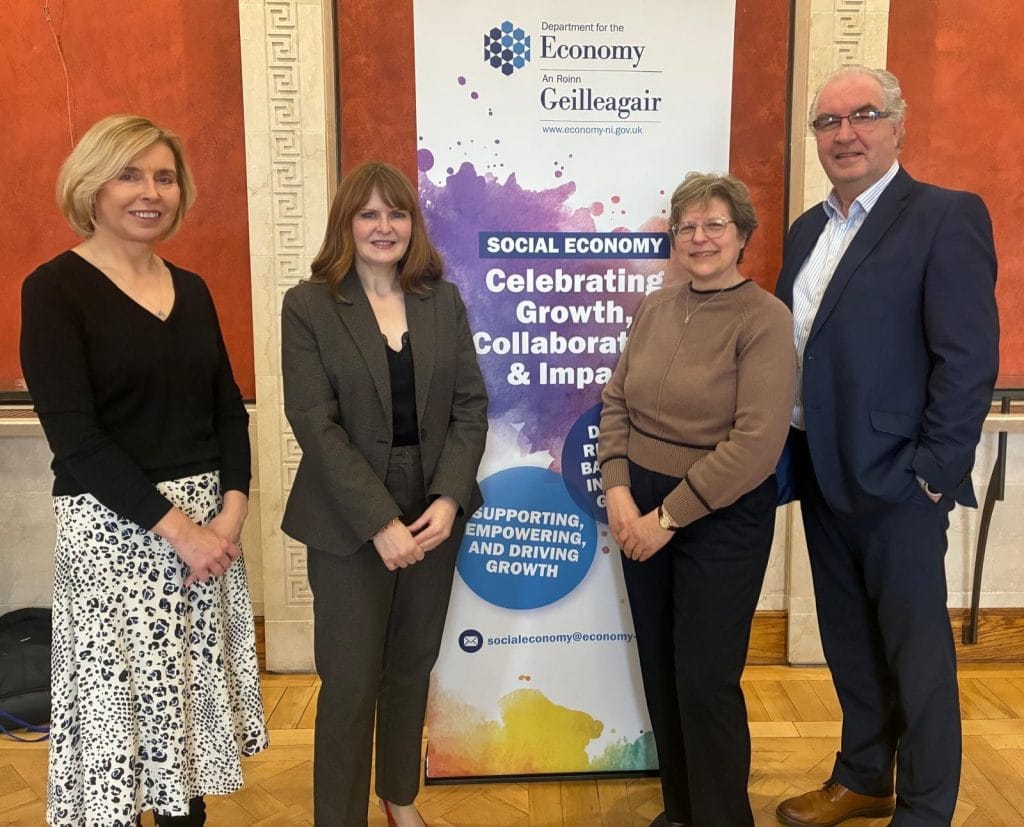
Employee Ownership Ireland was pleased to take part in the Department for the Economy’s Social Economy Showcase at Parliament Buildings this week, joining organisations from across Northern Ireland to discuss growth, collaboration and impact across the social economy.
The event brought together a broad mix of organisations working in social enterprise, cooperatives, community wealth building and employee ownership. It was a valuable opportunity to share perspectives, strengthen relationships and make sure employee ownership continues to be recognised as part of the wider social economy conversation in Northern Ireland.
Our Chair, Karen Maguire, took part in the panel discussion during the event, where she spoke about the role employee ownership can play in supporting business succession, protecting jobs and helping successful businesses remain rooted in local communities.
For Employee Ownership Ireland, being part of this event mattered. It showed that employee ownership is increasingly being understood not as a niche idea, but as a practical and credible model that can deliver both economic and social value.
Employee Ownership Ireland at Stormont
As awareness of succession challenges grows across Northern Ireland, employee ownership has an important role to play.
Many business owners are beginning to ask what happens next. They want to protect the business they have built, look after their people and avoid seeing ownership move away from the communities where those businesses were created.
That is exactly where employee ownership can make a difference.
By allowing ownership to transfer into an Employee Ownership Trust for the long-term benefit of employees, businesses can continue trading under their existing leadership while creating a succession route that supports independence, continuity and local impact.
The Social Economy Showcase created an important platform to make that case.
5 Key Takeaways from the Social Economy Showcase
1. Employee ownership is now part of the mainstream social economy conversation
One of the clearest messages from the day was that employee ownership is being recognised alongside social enterprise, cooperatives and community wealth building as part of the wider social economy landscape.
That matters.
Employee ownership is often discussed only in the context of tax or legal structure, but its impact is much broader. It helps businesses stay independent, supports stronger employee engagement and keeps wealth circulating in local economies.
Its inclusion in this conversation reflects a growing understanding that ownership models shape economic outcomes.
2. There is growing interest in practical models that deliver both business continuity and social impact
A strong theme throughout the event was the need for models that do more than sound good in theory.
Northern Ireland needs practical solutions that can help businesses survive, grow and transition well. Employee ownership offers exactly that.
It is a proven succession option for business owners who want to step back without selling to a third party, losing the culture of the business or putting jobs at risk.
For many founders, that balance matters just as much as the financial outcome.
3. Karen Maguire’s panel contribution helped strengthen the case for employee ownership
Karen’s participation on the panel was an important moment for Employee Ownership Ireland and for the wider employee ownership movement here.
She brought a clear and credible perspective to the discussion, highlighting that employee ownership is not just a governance model. It is a long-term approach to stewardship.
Her contribution reinforced the point that employee ownership can help founders protect the identity of the businesses they have built, while creating stronger long-term alignment between ownership, leadership and employees.
That message is increasingly relevant as more business owners begin to think seriously about succession.
Why Employee Ownership Ireland Matters in the Social Economy
Employee Ownership Ireland exists to make employee ownership more visible, more understood and more accessible across Northern Ireland.
That includes:
- raising awareness of employee ownership as a succession option
- helping business owners understand how Employee Ownership Trusts work in practice
- supporting advisers and professional services firms with practical insight
- sharing local examples and case studies
- building a stronger employee ownership ecosystem across Northern Ireland
Events like the Social Economy Showcase matter because they create the space to connect these conversations. They also help ensure that employee ownership is represented where future thinking, policy and collaboration are taking shape.
What Karen Maguire Said About Employee Ownership
Karen’s presence on the panel also helped underline an important message.
Employee ownership should not be treated as a niche or specialist option. It is a practical and scalable model that can help address real challenges in Northern Ireland’s economy.
It can:
- support founder succession
- protect jobs and leadership continuity
- keep successful businesses locally rooted
- create stronger employee voice and long-term engagement
- align commercial success with broader community benefit
That is why it belongs in conversations about the future of the social economy.
4. Collaboration across the sector will be essential
The Department for the Economy’s focus on bringing organisations together was welcome and necessary.
No one organisation can grow the social economy alone. Real progress depends on stronger links between social enterprises, cooperatives, community wealth building organisations and employee ownership advocates.
There is clear overlap in the ambition behind these models:
- stronger local economies
- more resilient businesses
- broader participation in wealth creation
- long-term thinking over short-term extraction
The opportunity now is to turn shared language into practical collaboration.
5. Northern Ireland has a real opportunity to grow employee ownership
The final takeaway is the most important one.
Northern Ireland has a real opportunity to grow employee ownership significantly over the next few years.
As more business owners face succession decisions, employee ownership offers a route that protects legacy while supporting long-term economic resilience.
That opportunity will not grow by accident.
It will require:
- continued awareness building
- stronger adviser engagement
- practical examples from local businesses
- joined-up support across the ecosystem
- visible leadership from organisations willing to champion the model
That is exactly why Employee Ownership Ireland continues to do this work.
Looking Ahead for Employee Ownership Ireland
We were pleased to be part of this important event and to see employee ownership included in a wider conversation about Northern Ireland’s economic future.
We are also proud that our Chair, Karen Maguire, was able to represent Employee Ownership Ireland on the panel and help make the case for employee ownership in a room full of key stakeholders.
Employee ownership is not just relevant to the social economy. It is one of the most practical tools available to business owners thinking about succession, independence and long-term impact.
As these conversations continue, Employee Ownership Ireland looks forward to working with the Department for the Economy and partners across the wider ecosystem to help more businesses understand what employee ownership can offer.
If you are a business owner considering succession, or an adviser supporting clients with long-term planning, we would be delighted to speak with you.
Learn more about employee ownership and the support available through Employee Ownership Ireland.